Now Reading: Why Kenyan Investors Are Playing Defence in a Record Market
-
01
Why Kenyan Investors Are Playing Defence in a Record Market

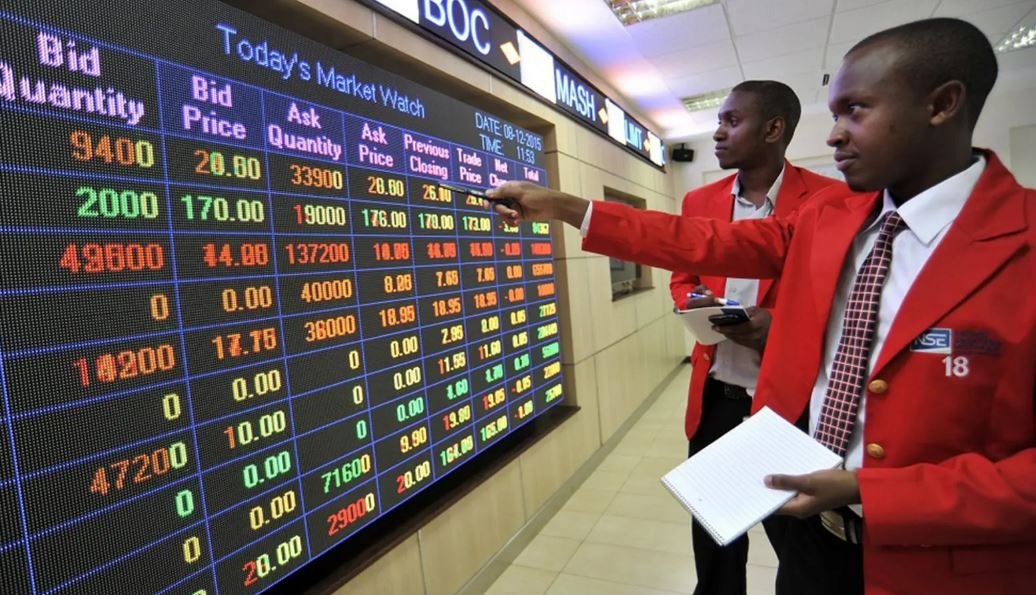

NAIROBI, February 10, 2026 — A significant strategic shift is underway in Kenya’s financial markets as institutional and retail investors move billions of shillings into defensive assets, despite the Nairobi Securities Exchange (NSE) hitting unprecedented highs this month.
This defensive rebalancing—a flight to stability—signals growing caution among market participants who are securing profits amid what analysts describe as “frothy” valuations and changing yield dynamics.
The NSE All Share Index (NASI) closed at a historic 202.73 points in early February, marking a remarkable bull run. Simultaneously, however, the Central Bank of Kenya’s latest auction data reveals a continued decline in Treasury bill yields, with the 364-day paper falling to 9.20%—down substantially from the double-digit returns that characterized 2025.
This convergence of record equity highs and softening fixed-income returns has triggered what market strategists are calling “the great defensive pivot.”
The Yield Compression Catalyst
“Investors face a fundamental dilemma,” explained Faith Muthoni, Chief Investment Officer at Sterling Capital. “The equity market offers paper gains at stretched valuations, while traditional safe havens like Treasury bills offer diminishing nominal returns. The logical response is to lock in profits and seek quality income elsewhere.”
Government borrowing costs have successfully decreased, with the Treasury replacing older debt costing 15.5% with new paper near 10.5%. This fiscal prudence translates to estimated savings of KSh 5 billion for every KSh 100 billion refinanced but reduces income for conservative investors.
Consequently, the money market fund sector has ballooned to KSh 400 billion in assets under management, though yields show dramatic dispersion from 4.19% in bank-led funds to 16.3% in top-performing alternatives like Gulfcap MMF.

Treasury bill yields across all tenors have declined from 2025 peaks, prompting investors to seek alternative defensive positions.
Dividend Stocks Become Defensive Anchors
Rather than exiting equities entirely, sophisticated investors are rotating within the market toward companies with established dividend histories. This strategy provides what analysts term a “yield cushion” against potential volatility.
“Dividend aristocrats on the NSE have become defensive pillars,” noted Eric Mwangi, head of research at Genghis Capital. “Stocks like Standard Chartered Bank Kenya with a 14.0% indicated yield and BAT Kenya at 10.96% offer tangible income streams that buffer against price corrections.”
Market data reveals concentrated buying in select blue-chip stocks:
- Stanbic Holdings (SBIC): Yield 10.33%, price surged 9.43% in early February
- Safaricom (SCOM): Announced KSh 0.85 interim dividend, book closure February 25, 2026
- EABL: Declared KSh 4.00 interim dividend, payment scheduled for April 30, 2026
Inflation Dynamics and Secondary Market Paralysis
Supporting the defensive shift is Kenya’s improved inflation outlook, which eased to a six-month low of 4.4% in January 2026. This provides positive real returns for most T-bill investors despite falling nominal rates.
However, the secondary bond market shows signs of strain, with weekly turnover plunging 20.2% to KSh 57.52 billion in early February. “Investors are clinging to high-yielding bonds from 2024 and 2025,” observed Renaldo D’Souza of Sofgen Securities. “This creates liquidity paradox—ample cash in money markets but limited trading in bonds. Everyone’s waiting.”
Also Read: Kenya Enters “Electionomics” as 2027 Countdown Triggers Economic Split
Political Horizon and Global Context
With the 2027 general election now visible on the political horizon, the defensive rebalancing also reflects typical pre-election caution in Kenyan markets. This local dynamic mirrors global trends where money market funds have swelled to $8 trillion worldwide despite rate cuts.
“Kenya’s version of defensive rebalancing is uniquely shaped by our political calendar and monetary policy trajectory,” said political economist Dr. Grace Otieno. “Investors are positioning for potential volatility while maintaining exposure to quality income generators. It’s less about predicting disaster and more about prudent positioning.”
Market Outlook and Strategic Recommendations
Financial advisors are recommending clients increase allocations to selective money market funds and high-dividend stocks while maintaining T-bill exposure for stability. Most suggest defensive positions should comprise 30-40% of portfolios until market direction becomes clearer.
“The defensive pivot represents market maturation,” concluded Lynette Kivuti of Alpha Frontier Capital. “Investors have transitioned from growth chasing to wealth preservation. In today’s market, the most aggressive move might be choosing to be defensive.”
Previous Post
Next Post