
Now Reading: AI agents are about to change how businesses operate
-
01
AI agents are about to change how businesses operate



The next phase of artificial intelligence will not be defined by what a chatbot can tell an employee. It will be defined by what AI can do without being asked at every step. AI agents for business are emerging as software systems capable of understanding goals, planning multi-step tasks, interacting with business applications, and taking action with human oversight. That shift could fundamentally change how companies organize work, buy software, and serve customers. The result may be an economy where businesses increasingly manage teams of people alongside teams of digital workers.
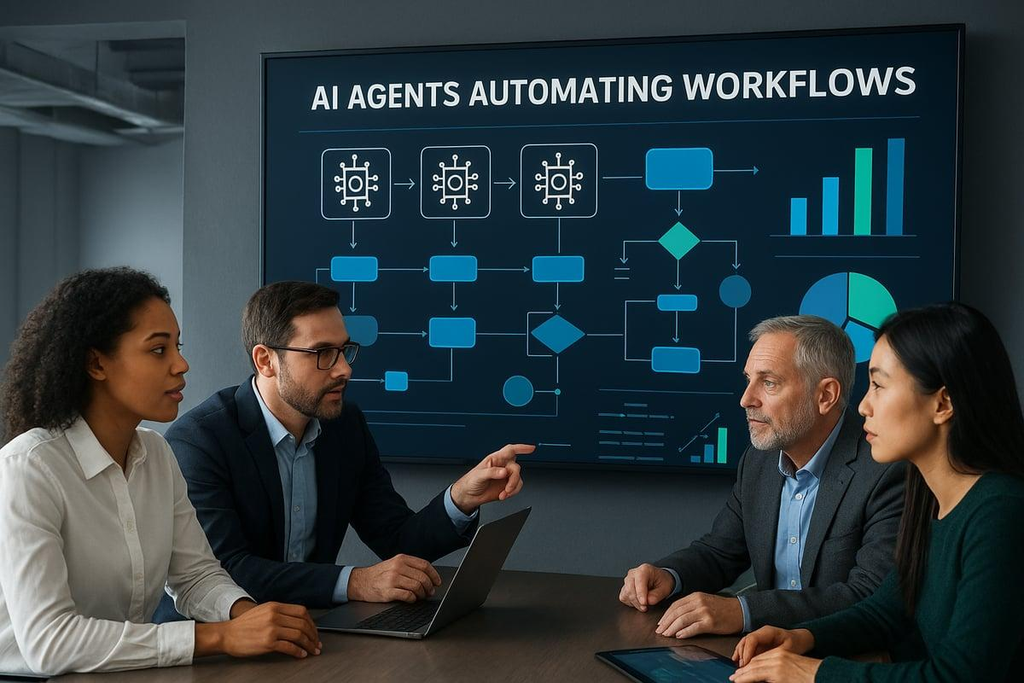
AI agents for business could turn software into digital workers
Traditional business software waits for employees to tell it what to do. A salesperson opens a CRM, searches for customers, and sends follow-ups. An accountant moves between financial systems. A customer-service employee reads a request, checks several databases, and decides what action to take.
AI agents for business reverse that relationship.
An agent can be given an objective and then coordinate multiple steps across existing systems. Google Cloud describes the emerging model as one in which agents can understand goals, develop plans, and act on behalf of employees, while companies increasingly connect multiple agents to execute complex workflows.
Imagine a sales agent that identifies a promising lead, researches the company, updates the CRM, prepares a personalized proposal, schedules a meeting, and alerts a human salesperson when a high-value decision requires approval.
The technology therefore moves beyond automation. Traditional automation follows predetermined rules. Agents can increasingly interpret changing information and decide which action should come next.
That could make them particularly valuable to SMEs, which often have limited staff but large administrative workloads.
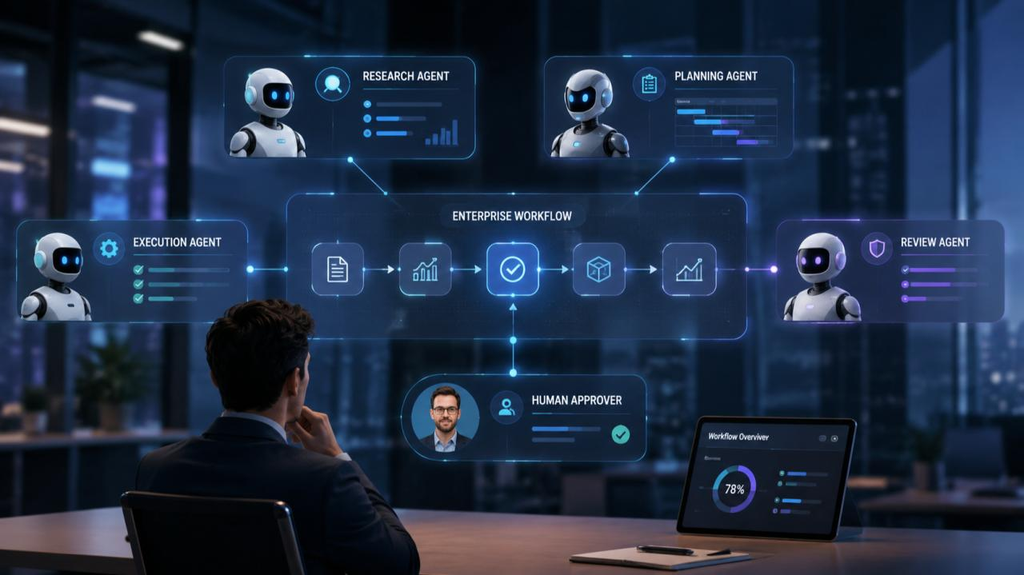
AI agents for business could disrupt the software industry
The biggest disruption may not happen inside companies. It could happen to the technology industry itself.
For decades, businesses have bought software applications for specific functions and paid according to the number of employees using them. AI agents could weaken that model by operating across several applications on behalf of employees.
Gartner estimates that up to $234 billion of enterprise application spending could be exposed to “agentic arbitrage” by 2030, representing roughly 20% of enterprise SaaS spending. The reason is straightforward: if an agent can complete a task across multiple systems, employees may need to interact with fewer traditional software interfaces.
That changes the value proposition of technology. Businesses may care less about how many features an application contains and more about whether it can produce measurable outcomes.
A CRM that merely stores customer information could lose ground to an agent that actually generates sales. An accounting platform that only displays financial data could face competition from an agent that reconciles accounts, identifies anomalies, and prepares reports.
For technology companies, this creates a difficult transition. The winners may be those that become the infrastructure through which agents operate rather than simply the applications employees click through.

AI agents for business will reshape jobs, management, and skills
The rise of AI agents for business does not necessarily mean humans disappear from the workplace. It means the definition of work changes.
Employees may increasingly become supervisors of digital workers, setting objectives, reviewing decisions, and handling exceptions rather than completing every repetitive step themselves. Deloitte argues that the full value of agentic AI will require organizations to redesign processes and workforce models rather than simply add AI tools to existing jobs.
That creates a new management challenge. Companies will need clear rules governing what agents can access, which decisions they can make, and when humans must intervene. Data security, accountability, and auditability will become as important as technical performance.
The competitive advantage may therefore shift from simply having AI to knowing how to organize humans and AI effectively.
For African businesses, that distinction is particularly important. Companies do not need to replicate the technology budgets of Silicon Valley to benefit. An SME could deploy agents for lead generation, customer follow-up, bookkeeping, procurement, or internal reporting and effectively gain digital capacity without hiring an entire department.
But the real transformation will come when businesses stop asking, “Where can we use AI?” and start asking, “Which parts of our business should no longer require a human to execute every step?”
That is when AI agents stop being software features and start becoming part of the workforce.
Related Posts


Previous Post
Next Post



Pingback: AI is changing how Kenya sells its tourism experience