Now Reading: Jumia Targets Profitability by 2027 After Exiting Underperforming Markets
-
01
Jumia Targets Profitability by 2027 After Exiting Underperforming Markets



Over the last two years, Jumia has ceased operations in poorly performing Algeria, South Africa, and Tunisia to cut losses and focus on stronger African markets like Kenya and Nigeria.
In the latest move, the New York Stock Exchange (NYSE) listed e-commerce giant announced the Algeria exit in February 2026, citing structural challenges, including restrictive import policies, a heavily cash-based economy, and intense competition that made profitability unsustainable.
According to Jumia, Algeria only accounted for 2% of Jumia’s total volume (GMV) in 2025 despite high internet penetration.
In addition, Jumia had already severed ties with South Africa and Tunisia in late 2024 citing sluggish growth and fierce competition.
Amazon’s entry into South Africa, with its official launch in May 2024, has significantly increased competition in the local e-commerce market, making it difficult for established players and contributing to Jumia’s decision to exit the region. The move forced a strategic reevaluation for Jumia, which halted operations in both South Africa and Tunisia to focus on profitability in its core markets.
While leaving these markets, Jumia is doubling down on nine other African markets, including Nigeria, Egypt, Kenya, Ghana, Ivory Coast, Senegal, Tunisia, Uganda, and Morocco where it is improving its operational efficiency.
Economic Impacts for Jumia
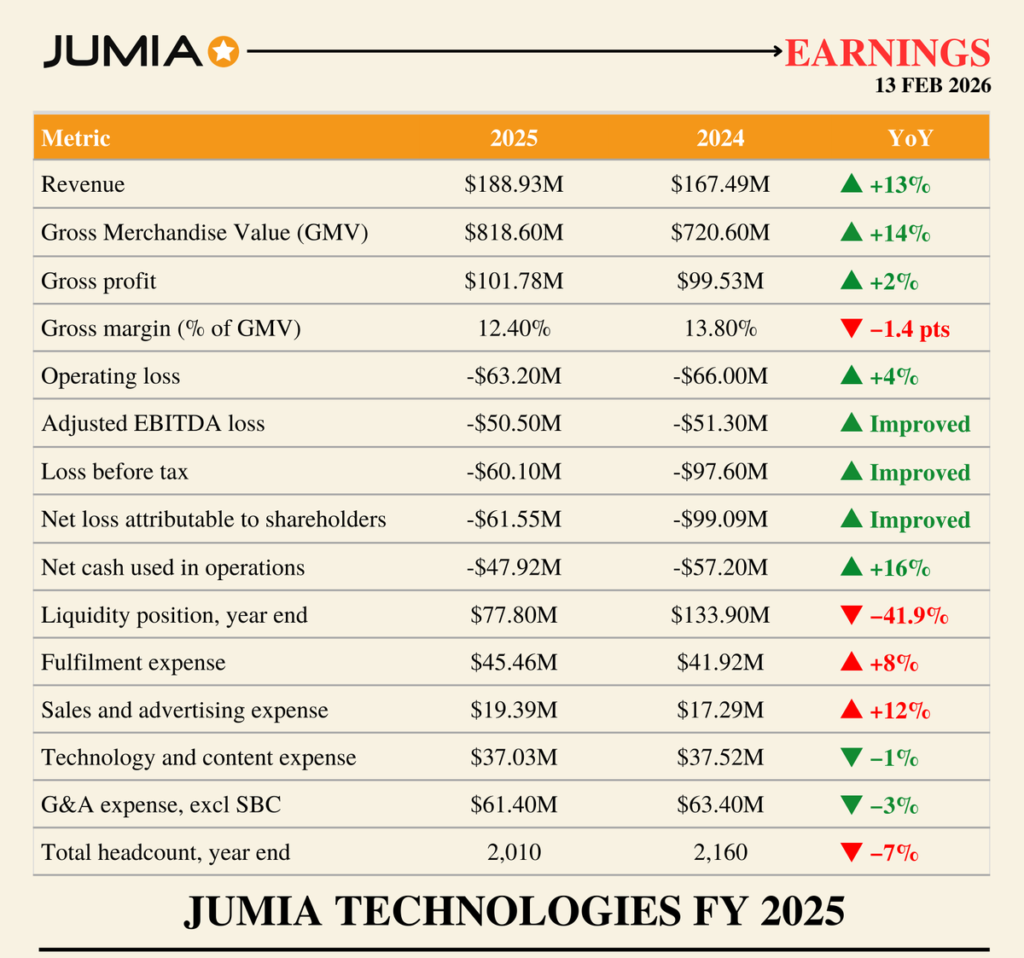
Based on Jumia’s fourth quarter and full-year 2025 results released in February 2026, the company has implemented a “leaner but stronger” strategy that has led to significant improvements in its operational efficiency and financial performance as follows.
- Staff Reduction & Efficiency: Headcount was reduced by 7% to just over 2,010 employees, aimed at optimizing costs.
- Logistics Savings: Fulfillment cost per order dropped 12% to $1.97.
- Reduced Cash Burn: Net cash flow used in operating activities in Q4 2025 dropped to $1.7 million from $26.5 million in Q4 2024.
- Narrowed Losses: The full-year loss before income tax was reduced by 38% to $60.1 million, compared to $97.6 million in 2024.
As a result, the company reported that its 2025 full-year revenue rose 13% to $188.9 million, while gross merchandise value (GMV) grew 14% to $818.6 million.
Despite operating losses only declining marginally by 4.24%, Jumia aims to achieve adjusted EBITDA breakeven and positive cash flow in the fourth quarter of 2026, with full-year profitability targeted for 2027.
Jumia’s Business Model is Also Adapting
Jumia is significantly shifting its business model, moving away from a primary focus on high-volume, high-value electronics towards Fast-Moving Consumer Goods (FMCG), groceries, and daily essentials, which now represent a growing share of the company’s Gross Merchandise Value (GMV).
The company is now positioning itself as an everyday life platform, partnering with brands like Procter & Gamble (P&G), L’Oréal, and Coca-Cola to improve its services and customer lead time in the various categories.

This strategic shift aims to improve service delivery at the local level, increase order frequency, and better meet everyday consumer demands.
As such, Jumia has expanded its logistics network to smaller towns and rural areas, where 60% of orders now originate, to meet the demand for convenience and affordability.
This transition is designed to create a more sustainable and resilient business model that is less sensitive to local and global supply chain disruptions.
A Bright Future Ahead for Jumia, But Challenges Exist
Jumia Technologies is navigating a complex transition from a high-burn growth model to a leaner, more sustainable structure, positioning itself for long-term potential in Africa’s evolving e-commerce landscape.
As a “first mover” with a robust distribution network, Jumia is well-positioned to capitalize on Africa’s young population, rising mobile penetration, and low, yet growing, e-commerce usage.
However, several significant hurdles remain that call for robust strategies and mitigation plans.
For instance, severe currency devaluations in key markets like Nigeria and Egypt, along with inflation, may negatively impact revenue and consumer purchasing power.
Further, despite improvements, Jumia may have to contend with poor road networks, high logistical costs, and lack of digital payment adoption in some areas that still have a high preference for cash transactions.
lastly, intense competition from both local players and international giants, who continue to increasing their presence in Africa may all for more proactive vigilance.
Jumia’s long-term future hinges on its ability to successfully manage these economic headwinds and build a trusted, reliable, and cost-efficient platform.
Read Also: Africa Doubles Down on Foreign Oil and Gas Investments as Libya Taps Chevron and Eni – Business News
Previous Post
Next Post
Previous Post

Next Post